Thursday, 4 February 2016

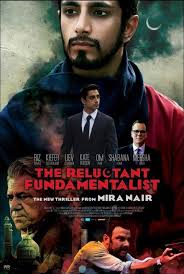
Reluctant fundamentalist

 The Reluctant Fundamentalist

The Reluctant Fundamentalist is film directed by Mira Nair. This is the book written by Mohshin Hamid. In this film we found one journalist Bobby Linkan(who is originally C.I.A. officer) he is taking interview of young Pakistani boy Changez Khan. Changez tales bought his Experian of working in America as Pakistani boy. Interview is taking for the investigation of kidnaping of American Professor. In this move we found that there is a conflict in his mind dream and real identity of America. He thinks that America is good but when he goes there and then he realized and come to know actual image of America as state. Real America is totally different from his dreamland America. Here we found identity crisis. He faces many problems as being Pakistani man. American people don’t put trust on man who has beard and mustache. Checking of Changez in airport of America is shows that that they can’t put trust on any Pakistani man. They think that they all are terrorist. In these move we also found relation of east and West Country. What eastern people think about western people? And what is the perspective of western people towards eastern people.
       In this movie director used flashback technique. Changez recollect his memories during his past in America. It is better and sweet memories, and tall to the journalist.
     

Sunday, 24 January 2016

ON@TCC

One Night @ The Call Center 


ON@TCC is written by Bhagat. It is considered as Self-Help book. 'Self-improvement' is term is modern name of 'Self-Help Book'. This kind of book help person to solving their problems all kind of literature is self-help. This kind of book take knowledge and anecdote from great book like, Ramayana and their holy books try to present in simple way. In this novel we found advice from above like call from God. Anti-traditional voice or DE traditionalism for example Radhika think about leave her mother in law and divorce Anuj, God also give permeation to Radhika to do, God agree with Radhika's decision self-help book deals with self-awareness and individuals performance. 


Manippean Satire Also known as varronian satire direct satire by author on society is known as Manippean satire. Author attests on institution not on Bossism by creating character of Bakshi. In tradition people think that old man in right but in novel Military Uncle are wrong in his idea that his daughter in low can't weak. Idea of Bossism is satirized in book. Character of Bakshi as boss is as villain. Manippean satire is always ante authority.


Popular literature is very famous among people. There is no cause and effect and lack of sustain plot. In popular literature generally there are shadow ideas, not deep philosophy and deep ideas. This kind of literature has no clear message. It never ended in clear cut ending. For example this novel is open ended and at the end of the novel writer told that if you wish God replace with Military Uncle you can read it on that way also. It is also love story, break up kind of story are normally found in popular literature. Here in this novel there is love story of Shyam and Priyanka.

Popular literature is very famous among people. There is no cause and effect and lack of sustain plot. In popular literature generally there are shadow ideas, not deep philosophy and deep ideas. This kind of literature has no clear message. It never ended in clear cut ending. For example this novel is open ended and at the end of the novel writer told that if you wish God replace with Military Uncle you can read it on that way also. It is also love story, break up kind of story are normally found in popular literature. Here in this novel there is love story of Shyam and Priyanka.

Narrative technique of Bhagat novel ON@TCC is very interesting rather than “life of Pi" by Martel. Bhagat use prologue and Epilogue. In this novel he also uses term dues ex machine through bringing God in the novel. Narrative technique of both the novels is same, but Bhagat try to present it in more interesting way. Other thing is that who is that lady? Who told story to author? At the end she says that if you want to replace God with Military uncle you can. Another is that lady is not one of six so another question that who is she? She told story to writer and writer tells the story through the character of Shyam.


“The Waste Land”

 “The Waste Land”


The poem “The Waste Land” is based on Christianity and faith in god. Eliot is believer of god, he use so many myth in this poem. At some point this poem is backward looking. Even his ideas are also backward and regressive. Because Eliot take help of Upnishada, Buddhism and Christianity for gating answer, solution of the contemporary problems or malaise. There is no doubt that all universal human laws are true. Eliot used all myth and historical fact as his weapon to prove his point.Friedrich Nietzsche is seems to be progressive and forward looking, when he gives solution of contemporary malaise. He believes in faith in self and concept of ‘superman’. Nietzsche believe that there is big different between modern malaise and mythical concept. In other words we don’t found our modern questions answer in past or in history (myth). 
Eliot believes that one must follows tradition for ‘salvation’. Sigmund Freud and Eliot both are opposite from each other. According to Freud for salvation one should be collective and individual balance, which should constantly take into account man’s primitive instincts. He says that there is no need of tradition for salvation. In this poem he talks about spiritual degradation and sexual perversion. He believes in ‘life in death and death in life’ the cycle of life.
We know that Eliot is also aware a bought Indian history, myths and Upnishada also. In this poem we found context of river Gunga, Upnishda, Prjapti and ‘what thunder said’. In thunder there are three type of ‘Da’. First ‘Da’ is data it means what we have given, be giver. When other gives their blood then we becomes happy. In other word their blood shaking or giving something makes us what we are today. Second ‘Da’ is Dayadhvam it means sympathies and empathies. Self ‘Ego’ is prison and it opened by ‘self’ only. Self is kind of master key for all kind of prison. Thread ‘Da’ is Damyata it means self-control and control over once passion and desires the life of senses. ‘The boat responded’. This all three ‘Da’ told by Prajapti to all mankind. Eliot use Shantih, Shantih, Shantih three time in the last line of the poem. It is symbolic one. It connects with absolute detachment for spiritual salvation. Eliot end it with hope that there is some good thing happened in ‘Waste Land’.

Film review of Midnight's children

Midnight’s Children


“Midnight’s Children” is novel written by Salman Rushdie. The film is directed by Deepa Mehta. The time of the novel and movie is during the partition of India and Pakistan. In the plot we found the story of three generation, story of grandparents, parents, and grandson. Mainly the story deals with, and tells the story of birth and life of Saleem. In film Saleem is the narrator of the story. We found that at the midnight there is birth of many other children, Shiva also. Two children take birth at same time and same hospital. One is belong to very rich family and one is from very poor. But nurse interchange both of them at that time rich become poor and poor became poor. We found that the use of ‘magic realism’ in this novel and film also. Sometime Saleem hears some kind of voice, it says that ‘we are your friends’ we are same like you’ ‘we born at same time’ (we all are midnight’s children). They all are magical children, and midnight’s children. That’s why the all hear each other, Saleem used to talk with them. One of them Shiva (is child with whom Saleem is interchanged) hates Saleem as he is child of rich family, so he used to fight with him. Saleem lives life of Shiva. At the end they both come to know that, they live each other’s life. Adam chilled of Saleem and Parvati also known as child of dignity. In the film Saleem speak one line that “I have much family and nonfamily”. Saleem leave his family and stared live with his mother’s sister and his uncle Zulfikar  Butto.

        When we applied post colonialism in this move, we found the birth of two children is symbolic. Here the birth of India and Pakistan. Politics of Indira is found behind the partition or in the birth of two states. In film we found one thing when partition of India and Pakistan, and the birth of Saleem and Shiva are going on, ‘something is going ending and something taking birth’ here two question that what is ending? And who takes birth? In the film nurse (she is Christian) interchange both child, then rich became poor and poor became rich. During partition of India and Pakistan British people plays vital role (they are also Christian).                                        

Tuesday, 19 January 2016

The Birthday Party- by Harold Pinter

 "Play Birthday Party"

The play ‘Birthday Party’ is written by Harold Pinter. This play is known as absurd play. But it is also full of deep philosophy of life. The sine of seducing of Lulu is coming in middle part of the play. But this sine shows nothing and so many things. We found in society this kind of things are happened everyday life. No one notes this kind of thing. Same in move he thinks that it is not necessary or not remarkable. This film is directed by Pinter himself, so he think that this seen was not important maybe this seen was not put in film version.
I have not read original text, but I have seen other film version of novel or play. I think that when we read text with feeling or emotion, with our own imaginative character and seen. When we watch movie of it gives sound effect. And through this sound effect of menace became strong. In a sense, all he gives us is texture the sound and sights of a world without structure; as we are shown clearly in the opening outdoor sequence of the film.  Which seems to be meaningless auction filled with visuals and inchoate sound? The sound of car is heard.
In move we found effect of lurking is gives danger felling. It is found when the game of blind man’s bluff was played in birthday party. It is also connected with the political game. But when we read we can’t feel that much lurking effect but when we visualize it, it essay became effective.
In play we found that Petey read newspaper to Meg. Petey hide himself behind it but newspaper, symbolically he hides himself but in real sense he faces the reality of society. Newspaper is kind of media who shows reality of society. In second seen we found that McCann cut newspaper. Cutting of newspaper is symbol of killing of time. At the last seen those pieces are hidden by Petey, it shows reality of Petey’s mind he hide something from his wife. Newspaper is symbol of communication. Husband and wife trying to make conversation, but it were unsuccessful. McCann rips newspaper in five equal parts.    
In the game of blind man’s bluff, it symbolized that man going in to darkness. Search for his identity or search for his existential identity. In this game glasses of Stanley were broken by McCann, it seems the vision of Stanly was changed by McCann. In film we found that camera is positioned over the head of McCann, through the camera we found that room is very narrow and it’s like cage. It also shows the narrowness of people’s mind.
Truth in art drama is forever elusive. Truth is that there never is any such thing as one truth to be found in dramatic art. This truth challenged each other, recoil from each other, and reflect each other. Sometimes we feel that we have truth for moment, then it slips through our fingers and it lost.
 This film is directed by Pinter himself so the characters all are appropriate.     


Saturday, 16 January 2016

My Presentation Video of Sem-3

 Presentation Video of Sem-3

 Presentation Video of Absurdity in Waiting for Godot and in Life


 Comparison of Hester and Mira


What is Orientalism?


Role of Institution in Language Study


My Seme2 presentations videos

Presentation video of Romantic Literature


Presentation video of Literary Criticism


Presentation video of Indian writing in English


Presentation video of Limitation of Cultural Studies